
Education: the hidden cliff
What would it take for a deleterious process to be stopped and replaced - on an assembly line, during building construction, when it is part of society. Furthermore, is there a tipping point, a cliff, beyond which any repair would be impossible? What follows is an analysis based on cognitive dynamics, a functional perspective from the ground up.
The above examples are in order of increasing complexity, from the assembly line to society, and the more the process involves the participation of humans the more complex it gets. Such processes are much harder to modify because they consist of a number of interconnected parts, each one of which would need to be taken care of on its own terms. When it comes to society we not only have many humans, each member comes with their own characteristics. Functionally speaking, we are dealing with a myriad of elements that do something. To illustrate the potential inevitability of a breakdown let's consider falling fertility rates with their consequences (indeed, the two - fertility rates and education - are related as we shall see).
The spreadsheet Otoom-FertilityRateCalcs.xls contains the necessary tables and formulas for our calculations. Out of the entire 224 available countries we'll use Australia as an example. Expressions such as B12 indicate a particular cell in the spreadsheet.
This year (2026) the population of Australia has reached 28 million, and according to the Bureau of Statistics data the average fertility rate is at an unprecedented low of 1.481 [1]. Open the spreadsheet and 28,000,000 appears in B12. B8 contains the fertility rate of 1.481. In Table A to the right under at year the first row has '30', which is the number of years onwards from the present, and under current population [1] we have '20,734', the number of people in 000's now 30 years later at that fertility rate (H8). (See the tab Help - About for further calculations, not needed now.)
The question is: If 30 years later the population has shrunk by just over 7 million, what would the fertility rate have to be to get the numbers back to where they started, and within the same time span?
Insert 20734000 into B12, and a fertility rate of 2.71 in B8 yields 28,095 in 000's in H8 (which is close enough). In other words, to get to the original population numbers we need women to have 2.71 children on average and consistently for the next thirty years. For comparison, the table to the right (M..) has countries ordered by Children/woman downwards, and the fertility rate of 2.71 would be somewhere between Honduras and Bolivia (in 2016 figures).
That's the math. In practice, the remedial actions are unachievable because fertility rates cannot be set from one day to the next, they will never be consistent across the entire society with all its individual conditions, the newly-born won't be able to contribute for many years (as well as being subject to cultural overlays) while the problem gets worse, and to maintain a directive for thirty years is unrealistic anyway. We could try for a less dramatic rate but that would mean extending the time frame considerably with its own problems of consistency, although the measures might be easier to implement.
(There is another aspect that adds to the problem: age cohorts. Assuming for the moment there will be a considerably higher number of young people (as unlikely as this would be), the success of the whole exercise depends on conscientious planning over three decades. For older adults a time span of thirty years is imaginable, less so for younger people. As Samuel Huntington has pointed out repeatedly in his book The Clash of Civilizations [2], a younger cohort is characterised by higher volatility, rebelliousness and impatience. Those traits are not inconsiderable, and where the younger age group predominates it leads to less stable societies prone to upheaval and altercation; many examples are listed. In our scenario we would have more and more members of a demographic that is even less able to follow through with the plan.)
What the table shows is the steady decline vs the increasing implausibility to rectify the situation. Today the actual population size in Australia is bolstered by immigration. This means that sustaining the numbers across the entire economy requires a continuous influx of migrants who meet the current and future demands of an industrialised nation. Since the type of migrant is hardly considered in the current climate of political correctness, immigration has become increasingly problematic, and not only in Australia. In any case, to compensate for a shortfall of 7 million over 30 years is no small task. Even if that can be achieved, it still leaves the resident demographics found wanting in a rather fundamental way.
Immigration and its consequences warrant a separate treatment, but for now let's consider the underlying principles. We have a complex dynamic system (ie, society) that operates within a framework of mutual dependencies and nonlinearity. Its functional elements (the society's members) influence each other such that any one of its elements can amplify and/or mitigate its neighbours across the time lines. For that reason influencing a single set of elements only can have unexpected consequences, now disengaged from some over-arching intent. Furthermore, an overall trend line is the culmination of several dynamics and, if part of an ongoing process, becomes virtually impossible to reverse or even modify due to its combinatorial nature.
And so to education. There too we find a number of factors that have combined to produce a result, and unless all of them can be addressed any solution will be questionable. In addition the functional elements (such as teachers), having gone through the same flawed process and now being compromised as well, supply their own deteriorated input which leads to further shortfalls. Just as an ongoing low fertility rate removes the basis from where remedial action could be taken (should one be entertained at all), if the education system is not repaired in time there will be no one left to do the repairing.
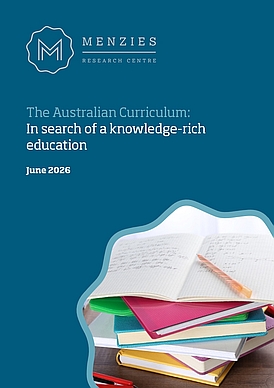
The recently published report The Australian Curriculum: In search of a knowledge-rich education [3] (from now on referred to as the Report) is used as a general guide since it highlights the main problems that have led to continuously decreasing standards in this field. The current perspective is one of cognitive dynamics, a deeper level. The following remarks should not be seen as a criticism, far from it. Because the issues mentioned there can be used as entry points to further delineations employing the dynamics underpinning all, the validity is thereby confirmed for both versions.
The Report's foreword sets the tone. Measured against OECD standards the educational outcomes in Australia are going down while at the same time the costs are higher compared to the OECD average, yet "outcomes have declined and children are more anxious, uncertain and less resilient" (page 3). The lack of resilience has many causes and is dealt with in the article How to build resilience [4]. So the Report's approach is logical: If a process delivers substandard results one must examine the steps involved in the process, and in the Report the focus is on the curriculum. Of course, someone has to design the curriculum in the first place and the Report does touch upon the wider political environment.
The overview of the history behind the development of the curriculum mentions the vagueness of the language in which the aims of Australia's education system are expressed. Phrases such as "general capabilities and cross-curriculum priorities" (p. 11) may suit a philosophical treatise on pedagogy but do not lend themselves to a precise outline of what it is a teacher is meant to say in the classroom, especially when Australia lacks a unitary system prevalent in most OECD countries (p. 18). Here federal, state and territory bureaucracies can come up with their own interpretations. This is not an argument against the nation's governance, but in the absence of an overall appreciation of what fundamentals mean the resultant content becomes ill-defined to the point where questionable priorities can be smuggled in under the auspices of romantic otherworldliness.
'Otherwordliness' is defined as "the quality or state of being concerned with the spiritual or imaginative world" [5], and this is exactly what is on display when it comes to ACARA (the Australian Curriculum and Assessment Reporting Authority) declaring, "The elaborations [on science and mathematics] acknowledge that Aboriginal Peoples and Torres Strait Islander Peoples have worked scientifically for millennia and continue to contribute to contemporary science" and they are "scientifically rigorous" [p. 18]. We are meant to accept that demographics who possess no literacy, no numeracy, where the language can have only 1000 words or less and counting barely reaches the number '10', that such severe restrictions on human thought nevertheless make scientific work possible. It goes against anything thousands of years of history teach us, from the Sumerians to ancient Egypt, to Greece, Rome, India, China ... let alone modernity (that's history by the way, not prehistory). More details on Aboriginal society are provided in The naked culture [6]. The Report quotes Neil Postman: "...by definition, there can be no education philosophy that does not address what learning is for. Confucius, Plato, Quintilian, Cicero, Comenius, Erasmus, Locke, Rousseau, Jefferson, Russell, Montessori, Whithead, Dewey..." [p. 13]. Yet under the nation's education system "subjects and areas of learning are viewed through an Aboriginal and Torres Strait Islander perspective" [p. 17].
Some of the mentality behind the otherworldly attitudes are mentioned in the above cited article How to build resilience [4], but the underlying streams (the cognitive dynamics) reach further. Over the last decades industrialised societies have reached a complexity completely different from the preceding millennia of human evolution. No one, however well trained, is capable of being familiar with everything a modern economy offers; the 'Renaissance Man' is no longer possible. As a consequence the immediate experience of anything outside one's personal reach has disappeared, to be replaced by an expected trust in regulatory authorities to ensure all the daily processes are flawless. Yet sometimes they are not, and in the general public's view the disappointment feeds a growing scepticism towards the overall system. One result is the often cited cynicism directed at politicians since they are the most visible representatives of the governing framework. Notwithstanding any possible personal failings and ideological predispositions, the average citizen would hardly appreciate what it means to balance the usually conflicting demands pressed upon our elected representatives. (It even comes down to the minutiae of the practical: How to grind a meeting to a halt? Appoint a committee to decide on the colour of the chairs. And that's just the beginning.) No wonder AI (especially agentic AI) is seen as a way to sift through mountains of information; see The world according to the machine [7]. Another consequence of a society's complexity is the proliferation of interest groups, each with their own version of a particular theme. The Report mentions a number of authorities vying for attention (p. 7) and thereby fracturing the main process.
A byproduct of such alienation has been the emergence of clusters isolated from the rest. Large enough to facilitate their own professional pathways and sufficiently influential to impact neighbouring groups, they are capable of protecting their failings yet interfere with their neighbours in any case. For example, we have academics who really believe calling the number '9' a 'pannikin' aids the numeracy of indigenous children (one example from The naked culture [6]). This sector of academia in a bubble (cluster A) relies on the status a university confers, uses its influence over an education department (cluster B), and wrecks the minds of school children (cluster C). Such are the walls separating A, B and C that neither of them allows for a conceptual overlap, an understanding of the other (rather like a delusional empress doling out cakes to the starving populace).
In the West the sophistication and diversity of industry is accompanied by a decadent antagonism towards its achievements. Partly fuelled by the above isolation, it also stems from an almost sycophantic bowing towards anything perceived as non-Western, no matter how brutish. The perception is somewhat ironic: as Professor Igor Bray is quoted in the Report, "Science knows nothing about the nationality or ethnicity of its participants, and this is its great unifying strength" (p. 18) and so a Western or any cultural basis has nothing to do with it anyway. On the other hand, being oblivious to the European Enlightenment prepares the ground for accepting Islam for example as conducive to a liberal democracy (no it isn't, see Words matter: on the National Response to Islamophobia [8]).
Interestingly, the Report does not deal with a fundamental feature of human activities: there is always a giver and a taker, one who directs and one who follows. ACARA's idea to teach recent Aboriginal history is worthwhile as such, but in a climate of subjectivity the full scope is swept away. In the classroom that complete view can serve as a ready-made object lesson about what happens when people are unprepared for whatever they might come across - or whoever comes across them. Furthermore, since the ill-effects of Western colonialism are already a favourite subject, the perception of colonising nations as mighty powers would be more subdued: to control people with guns and cannon is easy when the victims have only sticks and stones. Such is the influence of self-denigration that even this aspect is not recognised for its instructional value.
So yes, not mincing words when demonstrating the fate of a hunter-gatherer when faced with invaders who arrive by ship and carry rifles would surely impress any pupil, who later in life would exercise the discipline needed to stay on top of a situation. It makes for resilience [4] in a dangerous world.
And by the way, today's dangerous world with its globalisation and speed of information transfer renders the focus on a more local region less and less useful. The Asia-Pacific region is geographically close, but as disturbances in the Middle East keep showing, the effects can be felt anywhere.
Teachers, one side of the giver-taker equation, suffer from the increasing workload an overcrowded curriculum produces as the Report notes [p. 16]. Being a product of the self-same education system (which operates through its own post-modern predilections), what effective response can be expected when it comes to violent pupils and their parents? Not much, it seems: According to the Australian Principal Occupational Health, Safety and Wellbeing Survey by the Australian Catholic University's Institute for Positive Psychology and Education [9], "Reports of threats and physical violence [towards school principals] have increased over time, with 53.7% experiencing threats and 47.8% experiencing physical violence in 2025. Students are the most common source of physical violence, while parents are the main source of threats."
When even principals are exposed to attacks the teachers in class are in the front line. For Queensland alone, in 2025 there were 13,455 reports of occupational violence and aggression injuries to teachers and teacher aides, an increase of 13% compared to 2024 [10]. In practice, those data can stand for "classrooms being trashed", or teachers had "constantly evacuated the classroom when a child overturned desks and threw books". Even in primary schools there were 6916 injuries to teachers. As for the Queensland government, an additional $45m had been dedicated "to tackle unacceptable behavioural issues". One might ask, what are those 45 million used for, and just what does it take to put misbehaving kids (and parents) in their place?
The students - having been elevated in status from mere pupils long since - represent the other side of the giver-taker equation. Under those terms the tax payers need to cough up millions of dollars more because that side has become so powerful, its members are able to injure members of the other. It is to be hoped the teacher who played 'cat' in front of students like "Miss Purr" is the exception (yes, really - see [4] > Update - April 2025), but the left-leaning tone of universities [p. 17] would imbue their output with a politically correct Sendungsbewusstsein, a sense of mission to inspire their eventual audiences (that is, if the latter pay any attention at all).
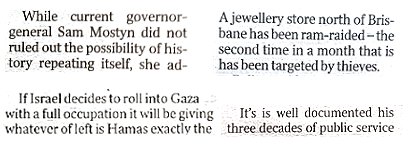
Snapshots of text errors. Clockwise l. to r.: 11/11/2025 -
19/06/2025 - 22/02/2025 - 11/08/2025.
The lack of gravitas and decorum immediately translates into less respect for authority figures, which teachers are supposed to be. It follows that what the authority demands to be known is not taken seriously either, which in turn is reflected in the lower educational standards. The Report finds it disturbing that according to the 2024 NAPLAN results 1 in 3 students are not meeting basic literacy and numeracy expectations [p. 14]. Leaving school, some of the students/pupils would go to university to become journalists, and of those some again would be employed by the Courier Mail, Brisbane's metropolitan newspaper. Above right are just four samples of the text the new crop has come up with; they are unlikely to be typographical errors (it should be pointed out that this is about grammar and sentence construction, not the quality of reportage on events).
Therefore, how their training prepares prospective teachers is important. Since their state of preparedness is a result of the atmosphere university courses offer, how academia sees education as part of society is bound to influence the ambience of its courses. Over the past decades the impact of feminisation has made itself felt, so much so that the system has spurned the masculine in favour of female-centred perspectives, priorities and aspirations. It obviously serves girls but boys are no longer taught according to their gender-based mentality. The latter's greater affinity with objectivity, clear demands and challenges are not served by the current preference for indistinct notions that are applied to virtually anything including the educational framework, as the Report makes clear. To quote from a (female) reader's letter as part of the boys/girls debate, "My topic, 'A gender in Crisis: Learning to Re-love Masculinity in the Highly Feminised Australian Primary School System: The Associated Impact on Boys' Development', was received with disdain, with one senior academic even telling me she found it highly offensive." And, "The problem arises when highly feminised environments insist that boys conform to expectations that do not recognise or value the ways many boys naturally think, learn and engage with the world." "I was literally shown the door," she wrote [11].
A particular human activity system that produces problematic outcomes such that its neighbours are affected as well, requires a comprehensive approach because it represents the confluence of several strands making up the whole rope. That's the nature of a complex reality.
One subset of its elements responds in the form of teachers whose dedication is undermined by their unpreparedness and the violence in their work environment. Many endure undue stress or simply choose to leave [12]. Job vacancies across Queensland alone tell the story; they can be as high as 12 for a single school.
Students, another subset, suffer from the system's imposed blindness towards specific variances, a hallmark of ideology. Positing that 'everybody is the same', it fails to distinguish between higher and lower performing students, rather than applying an appropriate level of education to either group. The higher performing ones get bored and disengage, and the others disengage because they can't keep up. Disruptions in the classroom make it impossible for both. Yet the system doesn't care.
On a similar note, the average member of wider society remains ignorant of what it means to live in a country with low education levels and an obsession with ideology and/or religion. They could travel to those other countries and experience the conditions first-hand but that is usually impractical given the existent pressures of their daily life and so they follow their own tastes and assumptions.
Ideology blinds its owner to the conditions and contingencies that are part of reality and, if prolonged, makes it virtually impossible to even recognise the barrier.
That is the cliff. Once reached, the society sinks to a lower standard, to whatever will be attainable under the circumstances. The system swallows itself.
PS: Here's how education was treated over sixty years ago in Austria: Memories of School [13].
1. Births, Australia, Australian Bureau of Statistics, https://www.abs.gov.au/statistics/people/population/births-australia/latest-release, 15 October 2025. Accessed 13 June 2026.
2. S P Huntington, The Clash of Civilizations and the Remaking of World Order, Touchstone Books, London, 1998.
3. K Donnelly, The Australian Curriculum: In search of a knowledge-rich education, Menzies Research Centre, Canberra, Australia, https://www.menziesrc.org/latest-reports-and-submissions/the-australian-curriculum, June 2026. Accessed 10 June 2026.
4. M Wurzinger, How to build resilience, https://www.otoom.net/resilience.htm.
5. Definition of 'otherworldliness', Collins Dictionaries, Glasgow, United Kingdom, https://www.collinsdictionary.com/dictionary/english/otho-i, 2026. Accessed 15 June 2026.
6. M Wurzinger, The naked culture, https://www.otoom.net/thenakedculture.htm.
7. M Wurzinger, The world according to the machine, https://www.otoom.net/worldmachine.htm.
8. M Wurzinger, Words matter: on the National Response to Islamophobia, https://www.otoom.net/wordsmatter.htm.
9. T Dicke (Project Lead), The Australian Principal Occupational Health, Safety, and Wellbeing Survey: 15 Years of Data, Institute for Positive Psychology & Education, ACU, Sydney, Australia, https://static1.squarespace.com/static/666032c06b6f9c6fdba32972/t/69b22efc59560b12fb1d7c80/1773285116257/Australian+Principal+Occupational+Health+Safety+and+Wellbeing+Survey+Annual+Report+2025.pdf, 31 March 2025. Accessed 17 June 2026.
10. R Innes, Student violence ... 'DV in schools', The Courier Mail, Brisbane, 16 February 2026.
11. M Layton, Groupthink danger, Letters, The Courier Mail, Brisbane, 5 July 2026.
12. R Innes, State Schools in Meltdown, The Courier Mail, Brisbane, 5 July 2025.
13. F Leisser, M Wurzinger (transl.), Memories of School, Fundamentals in education: Lessons from the classics, https://www.otoom.net/fundamentalsineducation.htm.
22 June 2026

© Martin Wurzinger - see Terms of Use