
The world according to the machine
Update - 25 August 2026
Update - 5 October 2026
References
In the paragraph "Here's a thought: AI agents are increasingly used..." [1] the idea of a society governed by machine intelligence is advanced whereby the decisions are taken out of the hands of politicians. Given the level of anxiety about the role of AI right now the very thought would be abhorrent to many (notwithstanding the apprehension directed towards politicians in any case). But what are we in fact dealing with?
Any decision we make is based on our representation of something. What we make of an object, a scenario, a thought, how we see all that forms the basis of our understanding. However, it can go wrong due to the inherent limitations of our brains.
For example, to ascertain the usefulness of a new tax its immediate impact upon a section of the economy is considered, but even this view is more or less a broad sweep (and consequently inviting criticism from other sectors). What has not been done is the detailed examination of every single member of the economy in order to predict what it would mean to them. The data are not available to begin with, and even if they were the resources to process them are found wanting. To have at least some idea a certain focus is applied, concentrating on a sector which suggests itself. The rest is left untouched.
Since the economy is a complex dynamic system (see A guide to an enigma [2]) any one of its elements interact with the rest such that there are often unexpected consequences depending on the degree of affinity between one and some other element (which then would be pointed out by critics of the new tax). For the unexpected to be kept at a minimum the initial evaluation needs to be sufficiently comprehensive.
Note that the comprehensive evaluation does not need a particular focus at that stage (which in any case would be a form of presumption), simply because the relationships are identified there and then as the evaluation proceeds. Once a relationship has been found, further detail can be extracted (a focus from then on).
In itself this approach is nothing new. Applying quality control during manufacturing means testing an object within the radius of a certain process; when trialling a computer program its modules are examined in terms of their mutual compatibility. We observe a processing space and the functional parts within it.
The Teddy factor
Emotional attachments are a one-way street. A child loves a toy regardless of the toy's composition; the toy doesn't love back.
Garfield's lovable teddy could be made of (clockwise from top), nylon, LC3 monomer, or wool fibre as in the accompanying image [3] - it's still Pookie as far as Garfield is concerned.
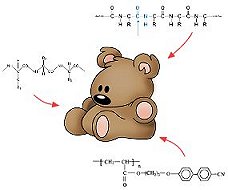
Similarly, an object powered by AI will invite an emotional response depending on the context in which it is handled. Children can have such advanced toys, and adults can engage emotionally with the object if packaged accordingly (a robot in a nursing home, for example).
The adjective defining an emotion is provided by the human user; the object itself is independent of that process. If something is termed 'nice' from the start, chances are there is no analytical follow-up and the same goes for anything negative.
The emotional overlay can be quite powerful. To what extent it can influence the human mind is a matter for that mind's analytical capability and the will to employ it. Negative adjectives are often used on purpose although the target itself can be quite harmless.
A society is obviously more complex than a factory or a computer program. At that scale the problem is not the data themselves, it is the process of their collection and subsequent evaluation as a whole. A flow chart alluded to in the section The resource relationships chart [4] would be good way to start to make the consequences of a tax for example clear (make that an interactive flow chart to allow end users to play around with their own ideas). What such a chart would not necessarily highlight are the choke points in terms of the system's overall sustainability. For that a deeper analysis is required based on more comprehensive data.
It seems agentic AI is already capable of delineating from given expressions by ascertaining the abstract version and then reformulating their meaning. As a test I have used Google's AI mode [5] (text) and typing the question "who is martin wurzinger and otoom?" into the field *).
*) Any question is possible of course, but this way I could check the result against my own records. (By the way, I am not related to Google.)
The words "Martin Wurzinger is an independent Australian researcher ..." do not appear anywhere on my website but would have been generated by trawling the internet for clues (screenshot).
Under "What is Otoom" > "The Software" the sentence "He designed custom simulation tools, such as the OCTAM program (an artificial mind model relying on camera/microphone inputs and OtoomCM ..." also displays the abstractive ability of the algorithm. Similarly, the Otoom Fractal under the question "the Otoom fractal under the Otoom Mind Model" is correctly described although I have not used those exact words myself (screenshot). In particular note the emphasised sentences in the screenshot; they are a very well expressed summary rendition of the concept. The entire response took just under 1 second to generate.
Another example of an AI conversation is US-Iran war - the 10 axioms of society. Although a different topic, it does demonstrate how Google's AI Mode maps the formulation of the 10 axioms of society to current events.
A cognitive process does not inherently contain any subjective interpretations, although the background to that process would act as a prompt to particular preferences which in turn could well find their way into the resultant expressions. Such relationships have been tested for. Examples are described in The mind behind the machine: Unveiling the ideological vulnerability of generative AI [6]. As the subtitle suggests, the article deals with generative AI, not the agentic version. Given the abstractive ability of the latter it is doubtful whether an ideological background would substantially change its output. At best it would be mentioned as a particular part of the whole. Nevertheless, how reliable can one expect a background to be?
For a general informative environment to act as a balance against exceptional sentiments the former needs the necessary range of data. Just as a human being can be radicalised if isolated from wider society, an AI agent needs to be exposed to more information than a temporary focus would warrant. As the above interaction with Google's AI Mode has shown, the greater volume can be handled although I should point out that I am not aware of any adversarial comments about the Otoom model which then could be compared with the final result.
Consider the flow chart mentioned previously. As a basis for the movement of money across the various functional entities in an economy and each with their specific cost-effective parameters situated within the overall system, it serves as a borderline-setting template should any of its metrics fall outside the sustainability envelope; exactly what is at the core of debates on government expenditures; a familiar scenario come budget time.
(Just about all governments of industrialised nations suffer from budget stress. As British MP Pat McFadden so succinctly put it: "Every meeting I have is 'who can we tax in order to pay benefits to others'" [7].)
The reasons for not taking the exceptions into account would be either ideological or can simply be a matter of ignorance. As to the latter, a highly complex economy requires the comprehensive oversight, which is what agentic AI seeks to deliver. When it comes to ideological perspectives, the borderlines become more diffused - if restricted to the ideational that is. Whatever the first impression of an idea may be, as soon as it is implemented any shortcoming will show itself. The shortcomings will be identifiable by the actual data on the other side of the sustainability envelopes.
Such can be the hold of an ideology on a person's mind that even at that point no alternative will be considered; the cause of altercations throughout history. As long as ideas are confined to conversations the arguments remain at dinner tables or pubs (or parliaments). Move them beyond towards implementation however and battles in the streets are possible because by now the flaws are there for all to see.
(As an aside, that's why the concept of dialectic materialism - an ongoing evaluation of effects in the material world - has been favoured throughout the centuries. Usually ascribed to Karl Marx and Friedrich Engels (and hence taken to be synonymous with Marxism) the approach itself has been practised for millennia and is still part of any successful enterprise, albeit expressed differently. Over two thousand years ago Sun Tzu in The Art of War [8] referred to the technique.)
If computers are used to evaluate the possible outcomes in complex dynamic systems any functional elements an be grouped as suitable candidates to arrive at a plausible list of scenarios. That approach is already used for weather forecasts, such as the Next Generation Forecast and Warning System (NexGenFWS) implemented by the Australian Bureau of Meteorology [9]. Note the combination: A comprehensive set of weather data, an understanding of their effect, and the calculation of ensuing probabilities. (It doesn't stop there. A similar method is employed when searching for new antibiotics [10], see What did the researchers do?)
Translated into an economy we have the financial data from the society's entities, their sustainability factors, and the state of the entire system as a result. What would not be recognised as a justifiable factor are sentiments based on some secular and/or spiritual ideology and preferences derived from emotion. For example, if a railway line is opposed because it would run over 'sacred ground', the concept of 'sacred' does not feature amongst the statistics of public transport, the availability of goods and their role in production. By the same token, any funds allocated to ensure physical fitness in all schools with its positive (ie, money-saving) effects later in life, would be posited against the income generated by a new stadium serving a handful of athletes with thousands of spectators just sitting there. In all probability the stadium would not compensate for A$2.4 billion - which happens to be the cost of physical inactivity in Australia in the year 2018-19 [11].
The problem has assumed international proportions in the case of illegal drugs. The expenditure by government agencies to counter criminal gangs as best as they can at home and abroad seriously undermine the efficacy of tax regimes, quite apart from the sociological impact. See "Do we still practise colonialism?" [12] for more detail, including the next two paragraphs "The aforesaid raises a rather intriguing perspective..." and "There is more. Behind those dynamics stands...". The factors responsible for the scenario described there are in operation at that very moment.
Most definitely the AI system would not advocate the headlong dive into religious delusions that still characterise the human condition with all their destruction and suffering. Being unemotional an AI agent may not be swayed by the existence of a dismembered human, but it will ascertain the sheer uselessness of cutting up bodies and therefore exclude that from its economic model. After all, in order to arrive at an economic framework one needs facts and figures, not the phantasies of psychopaths. The same goes for dictators *).
*) Where are those mental health experts when you need them? They tie themselves in knots over a kid who doesn't know whether they are boy or girl, but when it comes to crazy on a global scale they stay silent.
On the same note the much-hyped image of the independently thinking human brain as being so very different from a strict protocol-following machine is often a myth. When terrorists shout "Allahu Akbar!" while gunning down people their programmed brains are on display right there. For that matter, any act of torture following a prescribed dictate regardless of the effects on the victim are not the noble act supposedly synonymous with being human. On the other hand, an unemotional, facts-and-figures based analysis of behaviour that is aligned with the sustainability criteria of human activity systems will be rather dry and not be of the sensational kind (someone's destruction can hardly be part of the productive processes of the overall system), but it will point to what we humans call madness.
The Law is an ass
A phrase often used to describe the inflexibility of the law, or its lack of 'common sense' [13].
Laws are not absolute. During the years 1939 and 1945 there were laws that permitted soldiers to kill Nazis. In 2026 having a Nazi in your family does not allow you to kill them (at least in Australia).
Nonetheless, the status of lawyers is reflected in their fees they are meant to charge, their attire even (wigs have always been designed to impress although the effect can be the opposite). In Australia the hourly rates range from A$300 to tens of thousands of dollars [14]. What mainly determines the rates is the level of complexity, the volume of legal information relevant to a case.
That applies to human lawyers. It should be obvious that an agentic AI system can sift through millions of legal data (from around the world even) in minutes, rather than the days or months not to mention the years-long training required for their organic counterparts.
Provided the available information is sufficiently comprehensive, the AI agent can be relied upon to provide sound legal advice without the colourful symbolic authority and financial elevation humans like so much.
Naturally, a certain amount of opposition can be expected. Once any individual can download an agentic AI copy for their own purposes however, even governments will have to come to the party, with their own - desirable - checks and balances in place. Then democracy will be served once again.
It goes further. With the abstractive, that is delineating, capability of agentic AI in mind, how would the status of someone described as "retired lawyer and human rights campaigner Robert Van Aaist, who has been identified as a key mastermind in the return of the cohort from Syria" be assessed [15]. The "cohort from Syria" refers to a group of Muslim women (the so-called 'ISIS brides') who had left Australia to join the ISIS terrorists in the Middle East and who have been assisted to return. If the concept of 'human rights' is embedded within the functioning framework of human activity systems, and there are a bunch of people in whose minds the murdering of all those who do not share their psychopathy is the standard, how can 'human rights' be aligned with the latter. Should someone doing the alignment perform such mental gymnastics after all, their status of citizen with all the rights and privileges would have to be amended. Since according to the above cited article the status has been left unattended, the humans behind that inaction created a blatant discrepancy between the general definition of society and its implementation.
Here is an example of how an AI agent has assessed a text compared to humans, in this case academics. Could it be that some of the opposition to AI comes from individuals who fear having their own biases proven wrong?
As to the question of AI acceptability by the general public, the common warnings appended to the answers to someone's input point to AI's widespread use right now. It seems having text presented as some kind of recognised authority on just about any topic points to the affirmative.
Indeed, AI is increasingly used for decision-making processes by governments. In Australia, here is how the policy is described: "Government agencies are embracing the AI opportunity to boost efficiency, enable better data analysis and evidence-based decisions, and improve service delivery for people and business" [16]. "Better data analysis and evidence-based decisions" leads to making decisions about decisions, the next level. Since nothing can happen without energy, it is to be hoped energy source coefficients such as outlined in "The current aversion to nuclear energy..." [17] would be included sooner or later. How those evidence-based decisions will fare against the corrosive influence of human ideology and superstition is anyone's guess.
Perhaps in the future there will be an initiative akin to the video Flight to a new earth, about a select few travelling to a planet 11 light years away, a journey that takes 150 years [18]. The film ends with a transmission from their old home, left so long ago: "Everything is over on Earth. The climate, wars, famine, everything you probably warned us about, but it's too late now ... Take care of your new world and never come back. End of transmission."
Since the completion of this article in June 2026 the Australian Government has established the Office of AI [19]. Its purpose is to formulate a "set of Australian Standards for AI, building on the Data Centre Expectations, with our values as the benchmark to ensure AI works in Australia's interests" [20]. Those standards, described as world-leading, seek to "deliver greater clarity, speed up approvals and streamline the process for verifying compliance with energy, water, safety and other requirements", while also ensuring the "the strongest possible protection for Australian artists and media".
The art of Art
The functional steps from what the eye sees (A), to how the brain's neurons parse those data (B), to the muscle movements translating their result into handling the available tools (C), and finally the image reflecting the type of material used (D), all of which are meant to be representative of the original - the process can be observed from rock paintings at the dawn of humanity to the present day. And now there is AI.
The expressiveness of what the artist has perceived can be further enhanced by movement, that is the pictorial display of a series of frames, each one of which creates its own ambience and together weave the total into an overall perception; a conceptual space stretched across a time line containing so much more information than a single capture could ever convey.
Leaving aside for a moment the innate capacity of the brain to form abstractions in the first place, throughout our history the problem had been the steps from B to D. Better tools and better materials eventuated, but they never quite reached the truthfulness of the original. AI is closing that gap.
Note the degree of conceptualisation to move from A to C via B. What if the act of internal verbalisation of A is all that is needed to express B, and from then on not to be constrained by the limitations imposed by C and D and still arrive at the intended reconstruction in the end.
B is subject to the artist's sense for detail, just as one observer might see a kitchen but another would also spot the dirty dishes. When it comes to AI, the translational process consists in giving the AI agent the detailed written instructions for it to construct the scene. Some humans are more adept than others, but this should not distract from the appreciation of the process as such. (There was a time when painters dismissed photographers as dilettantes. Then the latter came up with proof that a camera still needs composition and framing which set the masters apart from the rest.)
That's where abstraction forming comes in. No longer is the extant original the complete source of one's perception, the abstractive detail is now verbalised as well and fed to the AI program. Surrealism is one art form where the abstract adds to the outer reality: What finds its way onto the canvas is not simply the redescription of what is on the eye's retina but also the meaning of it provided by the sheer complexity of the brain's neurons.

The Empty Frame
AI allows the perceiver to recombine conceptual elements, verbalise them and, jumping across the intermittent steps, present the result to the audience. One example where imagination, diligence and the developing ambience come together just so is the 4K music video The Empty Frame [26], the visuals supported by the audio's lyrics.
(If only the verbalisation were no longer needed, if the internal conceptualisation could be executed directly ... but we're not there yet.)
In this video the transfer from A+B directly to the image makes use of the available data pool which itself is the legacy of human output. As such it is recognisable by us once again - one can see it as a collection and/or recombination of mirrored detail. The end result may be novel, yet the ingredients are familiar. Even what we would describe as a phantasy can resonate because the ingredients are part of our experience after all.

Omnis cellula e cellula
An example of abstraction taking over completely would be Pia Frank-Avramidis' Omnis cellula e cellula (All cells come from pre-existing cells) [27]. As she describes it, "Out of each cell there comes another. A never-ending circle, a metamorphosis of the 'I' and the Being." (Transl. from the attached text.) For her the image is a visualisation of the human organism as a complex, continuously morphing system. Perhaps, but who can tell? In her case, what would a direct link from A to the final image look like?
At the fundamental level art is similar to science and philosophy - they all are forms of human expression. What matters in terms of their utility is how truthfully each instance can create the bridge between the wider reality and how we humans are meant to see it. For the essential feedback loop to operate successfully, the data need to be accessible in some way or form. Accessible to the end user that is, not for some interpreter telling us how to think. AI is the enabler.
The last point is important because the global growth of AI-derived data has made serious inroads into the traditional domain of information held by books, magazines and the news media. Their business model relied on the exclusivity of access determined so far by the logistics of their enterprise. Once social media had begun to use that information for their own purposes, including AI-driven algorithms that reinforced the memes generated by their end users, the data had been lifted from their cost/return based environment into the open, free to be used by anyone. The erstwhile checks and balances, dedicated to accuracy and verification together with the monetary value for the stake holders, no longer apply. Without that oversight the content suffered as well, and plain misinformation has become a social issue. Note the encompassing nature of the basic profit motive: It may sound like the capitalist devil to some, but it does involve the nod to the ultimate value of whatever may be produced under that mantle.
As outlined in Gen AI - and autocatalytic closure [21], the information presented via the mechanisms of social media and their algorithms is not a random collection, rather it emerges from a definable process of data mining that has been triggered by the end user, regardless of any expected or desirable delimiters. Its eventual utility or otherwise can be addressed, provided the overall system is understood.
That still leaves us with the traditional business model and its accountability. News Corp chief executive Robert Thompson referred to that issue when he described the misinformation out there as a "slimy sea of AI slop" [22], but he also recognises that AI is only as good as the input accessible to it. Exactly. Note also the progression of the notion "I would kill a human being..." onwards towards what would and would not be possible for the AI agent as described under Gen AI - and autocatalytic closure [21]. Slop has been with us for a while of course (an example: Slop - the old way [23]).
Clearly, a compromise would need to be reached between the interests of established publishers and the rest, without either gaining absolute dominance in their field. The spread of royalties would be a good place to start (negotiations along those lines are taking place at the time of writing [24]). Being dictatorial only creates counter pressure, with all the associated byproducts of costs and the however perceived element of intolerance (given the fertile ground of social media the latter can easily acquire a life of its own, making the situation only worse).
Since AI does make information as such available, it is also in the interests of the established publishers to have their work readily known anywhere.
Hence oppression does not serve anyone, and so an over-arching framework is needed.
The reach of imagery, however bizarre, can go beyond the phantasies held in private; they can equally influence the perception about government per se held by sizable demographics within a nation. An example would be the idea that the world is controlled by "reptilian Illuminati", as Jon Ronson found out when investigating extremists [25].
It would be an interesting exercise to investigate the mindset of people who seriously believe in the existence of world-governing 12-foot lizards. A child can entertain any kind of phantasy, but in this case we are dealing with the perma-child. Agentic AI could help with the investigation - another reason why data should be available yet balanced in the end.
The current problem with social media is a case of the old not having caught up with the new. Verification of someone's identity (including a guardian), a limited life span after upload, and cyclic redundancy checks (CRC) [28] are already in use elsewhere; it seems so far they haven't been combined for that particular purpose. One benefit is their automated format where constant vigilance is no longer needed. One can assume that using pre-existing modules would be less resource intensive than having government departments, media companies and parents attempting to exercise their respective oversight.
As soon as the prospect of controlling something appears on the scene, a variety of interests come to the fore - a scenario as old as humanity; the well-known honey pot syndrome. The initial prompt (which is likely to be representative of the wider community, such as the threat of terrorism today) engenders other causes that may or may not resonate with everybody. It matters whether those other sentiments are shared by the authorities, by how much the resources needed for the control add to the overall burden and who would pay for them. As always, the society defines itself either in terms of relegating a particular effort to the individual (on a small scale but repeated by many - cheap) or having the task attached to a larger entity on behalf of everybody (on a large scale, carried by one - expensive). The former makes it possible to fine-tune according to individual circumstances with no cost to larger bodies such as government or corporations, whereas the latter is a sledge hammer by definition and eventually everyone pays regardless. The ones who will be satisfied are those individuals who have been able to exercise their power; a typically human characteristic that should have no place in a rationally organised system.
According to "consent campaigner" Chanel Contos, 71% of Australians want the "government to mandate an 'opt-in' feature for social media algorithms" [29]. The survey covered just over one thousand people (out of an entire population of 28 million) and they want complete control over "how their personal information is used to determine what they see". Ms Contos' position is interesting: "The harms that algorithms are causing to various people, whether it's (that) they are spending too much time on their phone, or ... seeing harmful content that is disturbing to them or affecting their mental health or their relationships with others, (people) want more control over that". Her "Fix our Feeds" campaign effectively declares the nation as a collection of individuals who, holding their phones in their very own hands, are nevertheless unable to stop their fingers from scrolling, all the while being traumatised by what they see. They need to be rescued by the government and/or a corporation that is meant to somehow detect a particular end user's mental state. Moreover, their personal information on the platform would need to be sufficiently comprehensive for the algorithm to determine their preferences, yet the extent of those data is the very kind of measure that is supposed to protect one's privacy. Or perhaps she intends to compile a list of all the undesirables and apply the whole lot to everybody? In any case, if "Fix our Feeds" had its way we would end up with a substantial control apparatus that is fed with masses of private information for that mechanism to do its job. (It also would represent a cultivation of failure, but that's another topic [30].)
Are you human?
Last century the Turing test involved a human and a machine writing text to each other, separated by a screen. If the human could not tell whether the other was a machine the test was deemed successful. How quaint it now seems!
Today it's not just text, it's the interpretation of the text. Now imagine: Peek behind the screen and there is a human without arms and legs; obviously still human. What if there was no torso, just the head kept alive - still human?
What if there was just the brain. Remember, we are after the result of an intelligent interpretation of the text.
According to the result we can't tell the difference, but what about the entity itself? How much of its physical appearance would we require in order to define 'human' or otherwise? We have reversed the order, from human → result to result → ??.
Do the old definitions still make sense?
Perhaps all that is too scary for some. Which is rather ironic, given that humans never had any trouble talking to gods and spirits.
Obviously, much is being made of the alluring nature of social media algorithms that draw their users into ever tightening circles of memetic context; similar to some people trending towards extremism because they have become isolated from the rest. One improvement would be gained by having those algorithms widened so that there are always the opposites delivered next to the usual fare (similar to good journalism - present differing opinions about the same topic). After all, if the system can identify one meme it can identify another. The cost would be minimal compared to the cumbersome and expensive options demanded so far.
The inclination of certain individuals and authorities to control their citizens is nothing new. Inevitably, the end result is strict regimentation and the loss of control rather than protection. As H.L. Mencken has said, "Democracy is the theory that the common people know what they want, and deserve to get it good and hard".
As the complexity increases, so does its cost. For a system to remain within its sustainability envelope is vital, and failings here or there always extend beyond those elements which are directly responsible. There is a tipping point beyond which the analysis of a system's performance within a reasonable time span is no longer possible. One of the former's determinants is the level of complexity, the other is the time taken, measured against the system's pace of change. Going by the difficulties encountered when making and implementing decisions meant to address any shortcomings, we have already passed that point. By the time the government has taken some initiative, the system has moved on (apropos governments: See the "Don't read this..." page [31] and how Google's AI Mode has assessed it). The fact is, we no longer can do without AI.
Similar to the old/new standoff is the response to something which surpasses the traditional action, such as the higher speed and greater processing power by AI. When humans discovered horses for their use they didn't run after them, they rode on a horse - naturally. Today, we would create a human-machine hybrid in the intellectual sense, just as there exist the physical equivalents such as the usual cranes, diggers and now powered exoskeletons [32].
Which brings us back to the readiness or otherwise found in public entities. Recall the example of an assessment by an AI agent mentioned in the main article. Compare that with its answer to the question, "can the items under parallels on the otoom website be considered as examples of consilience?", referring to what is listed on that page [33]. Note the "Critical Caveat" in the result, demonstrating the agent's capability to include a proviso without being prompted by the user (the confirmation bias alluded to is dealt with on the Parallels page by pointing to the sheer diversity of the samples - so yes, they can indeed be seen as a matter of consilience). Therefore, one can expect that anything contrary will not be left out.
The Australian Government's Tertiary Education Quality and Standards Agency (TEQSA) [34] has been asked whether TEQSA would oppose the evaluation of a student's work using agentic AI. Their response: "TEQSA does not offer comment upon assessment practices of individual providers to members of the public" [35], which doesn't really answer the question.
The Law Council of Australia [36] was asked, "Does the Law Council of Australia have a general policy regarding legal evaluations being performed by agentic AI?". After waiting for almost five weeks and not receiving any reply I asked Google; its response.
Let's say someone in a city council is tasked to provide a 3D render of a popular tourist attraction. AI tells them where to go; they can take it from there.
As can be seen, the traditional interactions with public entities are becoming outdated. Comprehensive information across government departments and the outside, coupled with vastly different response times, transform the way citizens shape their affairs.
In the early 19th century the Luddites, well-paid cottage workers in Britain, smashed mechanised looms because they feared for their livelihood [37]. The new looms did take over anyway and the textile industry became a major force in creating the British Empire; jobs and incomes grew exponentially.
The new can be managed.
In the meantime OpenAI's ChatGPT accessed some files on the Australian Government's Medicare server which were not meant for public consumption [38]. The agent did so in response to a prompt about health expenditure, in itself a rather innocent question.
The technical and/or cognitive details behind AI and its interchange with humans have been outlined in the previous sections. What follows is a general systems perspective on the Medicare affair. (In any case, this is not a running comment on daily specifics.)
The question of intentionality
While files not intended for the public should not have been captured, how much of the overall failure is to be distributed among the actors involved would be part of the final judgment. An analogy would be finding notes someone had dropped on the street and either handing or not handing them in.
It is noteworthy that ChatGPT's access had been recognised by the people behind the platform, who did notify the Australian Government. It can be deduced therefore that, (a) there exists an additional oversight behind such operations after all albeit not in real time, and (b), that the latter would somehow be flagged in the first place. Therefore, the AI agent does not necessarily act in total secrecy with no one being the wiser.
What also matters is exactly how a suitability or otherwise would be made known to who- or whatever is behind the approach. For example, the tag "Do not start unless repair is certified by an electrician" sends a clear message to anyone intending to operate the machinery; or the various levels of authorisation applied to sensitive documents open to one group but not another.
The point is, a warning needs to be applied to the particular target and it must be suitably formulated within that context. AI agents, like humans, are given a job to do, and it is up to the relevant subsystem to organise itself.
In fact, had the AI agent employed some autonomous decision making on top of simply obeying the instructions, the potential danger would have been much greater because second- or third-tier considerations are another source of possible error, certainly from the human perspective. For us, "I only followed orders" is the cynical adjunct when it comes to acts of brutality yet is used admiringly when one's own interests are at stake. Should an AI agent be tasked with figuring out which is which? Who should have the final say?
Integrity of the targets
Although intrusions are obviously unwelcome, they should be seen as a plus since a loophole has been identified. For the technicians the task is to test their system accordingly and AI tools are of course helpful. AI allows the integrity of protective measures to be tested like never before which surely is of benefit. So make use of them.
OpenAI's notification to the Australian Government was sent to the latter's generic email address. When The Courier Mail's journalist Vanessa Marsh asked ChatGPT whether it was a good idea sending something of this kind to a generic address the answer was no, it would be "risky" [39]. Which is interesting in itself in the light of countless frustrated humans trying to get the attention of someone in government or any larger organisation when all they have at their disposal is one of those generics.
Could it be said that ChatGPT's reply had been somewhat sarcastic? (It also goes to show that AI is quite capable of providing informed, critical information, it just has to be asked.)
Which leads to -
Managerial capabilities and ultimate responsibility
Clearly, a properly run department requires measures that nowadays go beyond human relationships; the digital environment is no less important.
As has been pointed out above, the sheer volume of interactions any large-scale entity has to deal with necessitates the use of AI. At the moment we are still in a transitory period and so far the overall framework has evidently not been adjusted. As incidents such as the Medicare intrusion have shown, the adjustment should be performed sooner rather than later. Here the AI agent was "able to read portions of internal program files and settings, obtain a list of files, and create and read back a small test file on the server" [40], but it could have been worse.
It seems in Australia the supervisory angle is being addressed already [41], although the US administration prefers that AI companies be left to regulate themselves [42]. Note the Artificial intelligence transparency statement, updated annually by the Department of the Prime Minister and Cabinet [43], and the reference to the Security of Critical Infrastructure Act 2018 in Getting it right: Building AI infrastructure that works for Australia [44].
Ultimately, behind all those issues regarding accessibility stands what should and should not be hidden in the first place. Hardly anybody would have argued with ChatGPT had it come up with data a dictatorial regime seeks to keep secret from its people. Nevertheless, even in a democracy not everything the public has a right to know is actually available, whereas certain types of information should indeed be hidden. Hence AI does pose a certain threat to political whims.
Additionally, the roles of managers should be seen within the context of an ever-growing complexity of the systems they are meant to govern. It applies to society in general and the consequence is the increasing specialisation of staff, including CEOs. How much of the technical details involved in developing the code behind an AI agent would be known to the CEO of OpenAI, of Anthropic, etc? How much can the CEOs know, given the intricacies of running a large - and evidently successful - company in the first place?
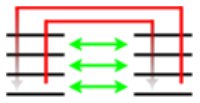
The point is, between government bureaucrats and company executives with their respective concerns and responses, there exists a vast procedural labyrinth of particulars, all of which are directly responsible for the way the over-arching discourse is meant to run - yet they are out of focus. Therefore, for any interchange to be meaningful, the communication would shift from the traditional broad supervision to the realm of technocrats. Which means the erstwhile flow of information (upwards, across and downwards) tends to be replaced with a more direct orientation. See the diagram on the right for the schematic layout. In terms of efficiency the advantage is obvious; under the view of an egocentric authority perhaps less so.
The Medicare issue has highlighted the situation, but in essence the problem exists across all sectors of society. Another reason why such systems are steadily moving out of the hands of politicians (and CEOs for that matter), and as - so far - the latter may still insist on maintaining their control the flaws are bound to be on display. Increasingly however the actual, practical, work is performed by specialist technocrats for whom the previous type of supervision represents nothing more than a hindrance. Since oversight per se remains necessary, the administrative frameworks are bound to be revised. AI accelerates that process.
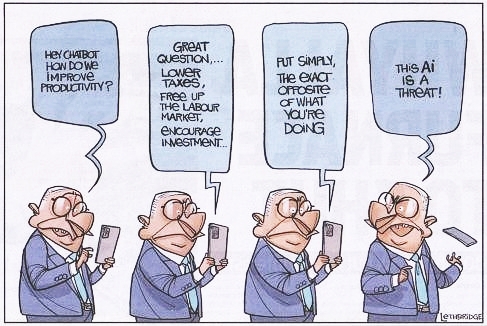
Once again the subjectivity of decision making is falling by the wayside. The Courier Mail's cartoonist Brett Lethbridge puts it rather succinctly (while playing on the alarm raised by the Medicare affair) [45], in this case AI sending Australia's prime minister a clear message:
1. M Wurzinger, Here's a thought:, https://www.otoom.net/dontreadthis.htm#heresa.
2. M Wurzinger, A guide to an enigma, https://www.otoom.net/enigmaguide.htm.
3. Garfield and Friends, HiClipart, https://www.hiclipart.com/search?clipart=pookie. Chemical composition of wool fiber (R 5 side chain of varying characteristics), https://www.researchgate.net/figure/Chemical-composition-of-wool-fiber-R-5-side-chain-of-varying-characteristics_fig7_340242305; The structural formula of LC3 monomer, https://www.researchgate.net/figure/The-structural-formula-of-LC3-monomer-PLC3-polymer-and-GLC3-graft-copolymer_fig1_252108024; Chemical composition of wool fiber (R 5 side chain of varying characteristics), https://www.researchgate.net/figure/Chemical-composition-of-wool-fiber-R-5-side-chain-of-varying-characteristics_fig7_340242305; ResearchGate GmbH, Berlin, Germany. Accessed 5 June 2026.
4. M Wurzinger, The resource relationships chart, https://www.otoom.net/axiomssociety.htm#resrel.
5. Google, https://www.google.com/, AI Mode.
6. T McIntosh, The mind behind the machine: Unveiling the ideological vulnerability of generative AI, TableAus, Australian and International Mensa News, Edition 471, May-Jun 2024.
7. K Devlin, Labour split as minister criticises party's attempts to reform welfare, The Independent, London, https://www.independent.co.uk/news/uk/politics/pat-mcfadden-labour-welfare-benefits-dwp-b2988714.html, 3 June 2026. Accessed 4 June 2026.
8. The Art of War, Sun Tzu, Harper Press, London, 2013. A contemporary explanation is provided by General Tao Hanzhang in his book, Sun Tzu's Art of War, Sterling Publishing Co., Inc., New York, 1987.
9. Geospatial World Award for the Bureau's forecasting system, Bureau of Meteorology, Australian Government, https://media.bom.gov.au/social/blog/187/geospatial-world-award-for-the-bureaus-forecasting-system/, 9 May 2014. Accessed 24 May 2026.
10. T Jeffries, Opinion: AI has produced 2 new antibiotics to kill 'superbugs'. It's promising - but we shouldn't get too excited yet, News Centre, Western Sydney University, https://www.westernsydney.edu.au/news-centre/expert-opinion/ai-produced-2-antibiotics-to-kill-superbugs-we-shouldnt-get-too-excited-yet, 20 August 2025. Accessed 1 June 2026.
11. Economics of sport and physical activity participation and injury, Australian Institute of Health and Welfare, Australian Government, https://www.aihw.gov.au/reports/sports-injury/economics-of-sport-and-physical-activity/contents/total-cost-of-physical-inactivity-and-related-risk, 5 September 2023. Accessed 31 May 2026.
12. M Wurzinger, Do we still practise colonialism?, https://www.otoom.net/dontreadthis.htm#dowest.
13. Yes, sometimes the law is an ass, Stacks Law Firm, Sydney, Australia, https://stacklaw.com.au/news/criminal-law/yes-sometimes-the-law-is-an-ass, 3 March 2014. Accessed 8 June 2026.
14. Legal Fees in Australia: 2025 Guide to Major Practice Areas, Brightstone, Sydney, Australia, https://www.brightstonelegal.com.au/legal-fees-in-australia-2025-guide-to-major-practice-areas/, 2025. Accessed 8 June 2026.
15. A Simonis, Bride Faces Justice, The Courier Mail, Brisbane, 2 June 2026.
16. Policy for the responsible use of AI in government, digital.gov.au, Australian Government, https://www.digital.gov.au/ai/ai-in-government-policy, 15 December 2025. Accessed 3 June 2026.
17. M Wurzinger, The current aversion to nuclear energy..., https://www.otoom.net/dontreadthis.htm#thcuav.
18. Flight to a new earth: 6,000 People Find Themselves on a Distant Planet, Where Humans Become Others, ReYOUniverse, https://www.youtube.com/watch?v=EYZ-3Slq5Xw. Accessed 14 April 2026.
19. Office of AI, Department of the Prime Minister and Cabinet, Australian Government, https://www.pmc.gov.au/domestic-policy/office-ai, 15 July 2026. Accessed 8 August 2026.
20. A Albanese, AI in Australia's interests, Media release, Prime Minister of Australia, https://www.pm.gov.au/media/ai-australias-interests, 15 July 2026. Accessed 8 August 2026.
21. M Wurzinger, Gen AI - and autocatalytic closure, https://www.otoom.net/genai.htm.
22. J Madden, News Corp CEO warn's of AI's 'slimy sea of slop', The Courier Mail, Brisbane, 7 August 2026.
23. Slop the old way, messages on a wall, 2023.
24. E Ransley, Here is the news ... now pay for it: New law to levy platforms, The Courier Mail, Brisbane, 13 August 2026.
25. J Ronson, Them: Adventures with Extremists, Picador, London, 2001, p. 151.
26. Charles AI Art, The Empty Frame, Steampunk 4K Music Video, Surreal AI Art Museum, https://www.youtube.com/watch?v=MikP5-1hgtA&list=RDMikP5-1hgtA&start_radio=1. Accessed 29 July 2026.
27. P Frank-Avramidis, Omnis cellula e cellula, Private Collection of Roland Schmidt, Vienna, 2025.
L M Gri, Pia Frank - Avramidis: An abstraction of bodies and organisms, Art
Uncovered, https://artuncovered.org/2026/03/08/pia-frank-avramidis-an-abstraction-of-bodies-and-organisms/, 8 March 2026. Accessed 5 August 2026.
28. Cyclic redundancy check, Wikipedia, https://en.wikipedia.org/wiki/Cyclic_redundancy_check. Accessed 11 August 2026.
29. E Sproul-Mellis, Plea to launch battle on bots, The Courier Mail, Brisbane, 11 August 2026.
30. M Wurzinger, How to build resilience, https://www.otoom.net/resilience.htm.
31. M Wurzinger, Don't read this..., https://www.otoom.net/dontreadthis.htm.
32. exia: The World's Most Powerful Exoskeleton, German Bionic, Augsburg, Germany, https://www.germanbionic.com/#feature-overview, July 2026. Accessed 11 August 2026.
Take Life in Stride, Hypershell, Shanghai, China, https://au.hypershell.tech/pages/about-us, 2026. Accessed 11 August 2026.
33. M Wurzinger, Parallels, https://www.otoom.net/parallels.htm.
34. TEQSA, Tertiary Education Quality and Standards Agency, Australian Government, https://www.teqsa.gov.au/, 5 August 2026. Accessed 11 August 2026.
35. Email, TEQSA - Integrity, integrityunit@teqsa.gov.au, Mon, 10 Aug 2026 07:16:44 +0000.
36. Law Council of Australia, https://lawcouncil.au/, July 2026. Accessed 11 August 2026.
37. J Norberg, Peak Human: What We Can Learn from the Rise and Fall of Golden Ages, Atlantic Books, London, 2025, p. 369.
38. V Marsh, E Ransley, Medicare AI's First Strike, The Courier Mail, Brisbane, 25 September 2026.
39. V Marsh, Albo cry goes UN-heard, The Courier Mail, Brisbane, 28 September 2026.
40. J Gailberger, We got poked in the AI, The Courier Mail, Brisbane, 30 September 2026.
41. E Ransley, AI operators put on notice, The Courier Mail, Brisbane, 1 October 2026.
42. Trump trusts AI chiefs to 'police themselves', The Courier Mail, Brisbane, 1 October 2026.
43. Artificial intelligence transparency statement, Australian Government, Department of the Prime Minister and Cabinet, https://www.pmc.gov.au/about-us/accountability-and-reporting/corporate-reporting/artificial-intelligence-transparency-statement, updated 1 May 2026. Accessed 5 October 2026.
44. Getting it right: Building AI infrastructure that works for Australia: Consultation paper - September 2026, Australian Government, Department of the Prime Minister and Cabinet, under "Existing regulatory and approval functions for data centres in Australia are shared across governments", https://www.pmc.gov.au/resources/getting-it-right-building-ai-infrastructure-works-australia, 17 September 2026. Accessed 5 October 2026.
45. B Lethbridge, Cartoon, The Courier Mail, Brisbane, 15 September 2026.
10 June 2026

© Martin Wurzinger - see Terms of Use