














CauseF program v. 5.0
See the Manual for more details about what the program does and why.
Download CauseF (14MB). Win 10, 64-bit. Freeware. Version 5.0 is considerably different from its predecessors.
The world is nonlinear. Reality, nature, is nonlinear. From the contents of atoms to the clusters of galaxies the constituent elements interact with each other in terms of their innate characteristics.
It is humans who, with the limited understanding of their surrounds, created constructs in a linear fashion because that's how they saw things (mostly they got away with it because boundary conditions were never reached - the old stagecoach wasn't a problem, but a jet turbine is another matter). And because they created linear assemblies they imagined there had to be a similar - ultimate - creator who must proceed likewise. A linear system requires a certain amount of forethought: In order to have a lever moving a wheel one needs a concept of that wheel to make a suitable lever in the first place, and if there is no wheel that lever is no longer a lever, it's just a stick. And not surprisingly, based on their linear version of the world, humans had a problem with the consequent concept of the 'ultimate cause': Philosophers and theologians always grappled with that question. As usual, a question that starts with a false premiss never leads to a useful answer.
Nature doesn't need such a creator. In a nonlinear system any manifestation is the result of previous interactions without which that particular result could not have happened. So, butterflies are not there to pollinate flowers. They exist because out of the reservoir of insects there occurred an ad hoc development that led to wings, no outside influence stymied their development, and the insect was able to travel in order to find food because there had been the development of plants featuring certain protuberances allowing them to propagate and the substances involved emerged in line with food-seeking animals where the food they required was in line with the plants existing at the time; which in turn gave rise to those animals that could make use of such food, which in turn helped the plants to proliferate, which in turn increased the potential for animals to diversify, which then in turn ... and so on and so on.
(One can extend that perspective to ourselves and our organs, as well as all the bacteria and any other organisms we carry at any given time. It would be a quite valid view - albeit not a conventional one - to see ourselves not so much as distinct individuals but as a multitude of temporary functional shells embedded within one another.)
The greater the number of the constituent elements making up any particular manifestation, the greater the potential for further complexity. Which is the reason why hydrogen will always be hydrogen, and iron will always be iron (not exactly true at the quantum level, that's a different system). But take a biosystem with its myriad of elements, from atoms and molecules to all the higher-level combinations of such fundamentals as they have formed over time, and we have the biodiversity on our planet today. Go back 500 million years and the diversity had been far less.
That's why greater complexity also makes for ever shorter time intervals between evolutionary stages because the resultant diversity enhances the potential for further developments. From the first beginnings of life it may have taken 400 million years to come up with invertebrates, then 200 million for reptiles, 20 million years ago we had anthropoids, and as for humans, we arrived just now. If there is such a thing as a creator, it is nonlinearity.
The first insight that there are systems which do not behave in a linear fashion comes from Henri Poincaré who in the 19th century studied the movement of planets, thereby contributing substantially to celestial mechanics. Among other things, the CauseF program allows the user to observe the changing orbits of virtual planets as they are influenced by the force fields of the sun and the planets themselves. If the orbits are rendered as paths the patterns are reminiscent of Lorenz attractor plots.
The user can interact with a system via four modules: With the characteristics of squares in a grid (Grid module); with balls moving around a table (Spheres module); with 'planets' as they orbit around a centre, the 'sun' (Planets module); or having force vectors acting on a cylinder causing it to resemble a bone (Bones module). The respective inputs affect changes in the inherent nature of the elements: The squares in the grid, the balls on the table, the planets in a virtual solar system, or the now modified shape of a cylinder. Although the changes are applied in a discrete manner (the values are real enough), what happens as a result overall is subject to the mutual influences between all the elements (ie, the squares in the Grid, the balls in Spheres, the globes in Planets, the effect of forces in Bones).
These four different systems have one thing in common: They contain functional elements (elements that do something) where each one of them changes its state through its interactions with the rest. What emerges are identifiable patterns, yet their details are unpredictable.
In space planetary systems (similar to our own solar system) are not unusual. Exoplanets even larger than our gas giants Saturn and Jupiter have been found, sometimes orbiting close to the sun (there was a time when it was assumed only smaller planets orbit a star as closely as in our solar system). In CauseF certain conditions cause large planets to form which in turn can orbit very close to the star (although such conditions only tend to emerge after several minutes if at all, see the Manual > Planets).
Under certain other conditions (determined by the program's current state at any time), a planet may eventually plunge into its sun. The vastly contracted timelines in CauseF (compared to the real universe) allow such events to be observed in the program. Incidentally, the James Webb Space Telescope has found one example of a planet eventually spiralling into its star; see the illustration on the NASA website.
Nonlinearity is everywhere. There are even economists who begin to recognise the complex nature of their field as Steve Keen pointed out (S Keen, Debunking Economics: The Naked Emperor of the Social Sciences, p. 246, Zed Books, London, 2004).
For further detail see the Manual. Or simply run the program and see for yourself, using the tool tips.
A summary of what's new in v. 5.0:
The entire Bones module.
Added tool tips to just about everything (they can be switched off).
Streamlined menus.
Streamlined file operations.
Grid:
Added more safeguards to menus.
Spheres:
Provided alerts for maximum numbers.
More efficient resets.
Planets:
Provided alerts for maximum numbers.
On-time alerts of changed fast-save conditions for Planets.
Removed useless eye-candy (camera views for sun and any planet).
Linked zoom effects to planet paths if shown at the same time.
More efficient resets.
Default options:
Extended default settings options to all modules.
On-time alerts of changed fast-save conditions for Planets.
A screenshot
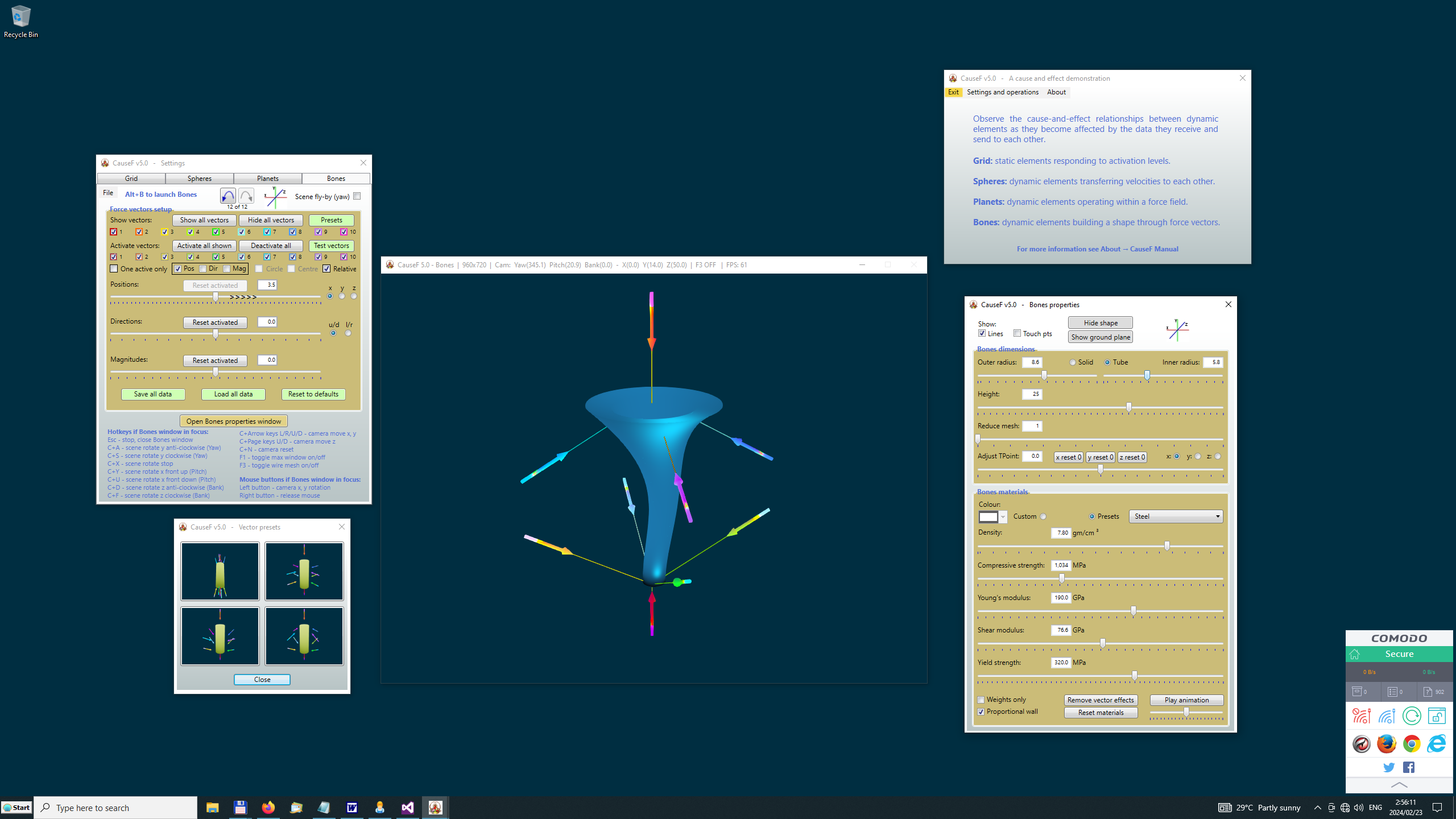
Bones module. Deployment of (clockwise, l. to r.): The Settings window for Bones; the Bones window with a cylinder (in this case hollow, assigned material: steel) and 10 force vectors placed around it showing their lines of force, with the cylinder's shape modified in
terms of compression and flexure (among others); CauseF Main window; the Bones properties window for the cylinder settings; and a window for selecting preset force vector configurations. Click on the image to view it at the 2560 x 1440 resolution.

© Martin Wurzinger - see Terms of Use